The Gorham Bible — Essay
The Digital Jefferson Bible
Jefferson took scissors to Scripture in 1820. He was right.
By Aaron Gorham · 12 min read
The Gorham Bible — Essay
Jefferson took scissors to Scripture in 1820. He was right.
By Aaron Gorham · 12 min read
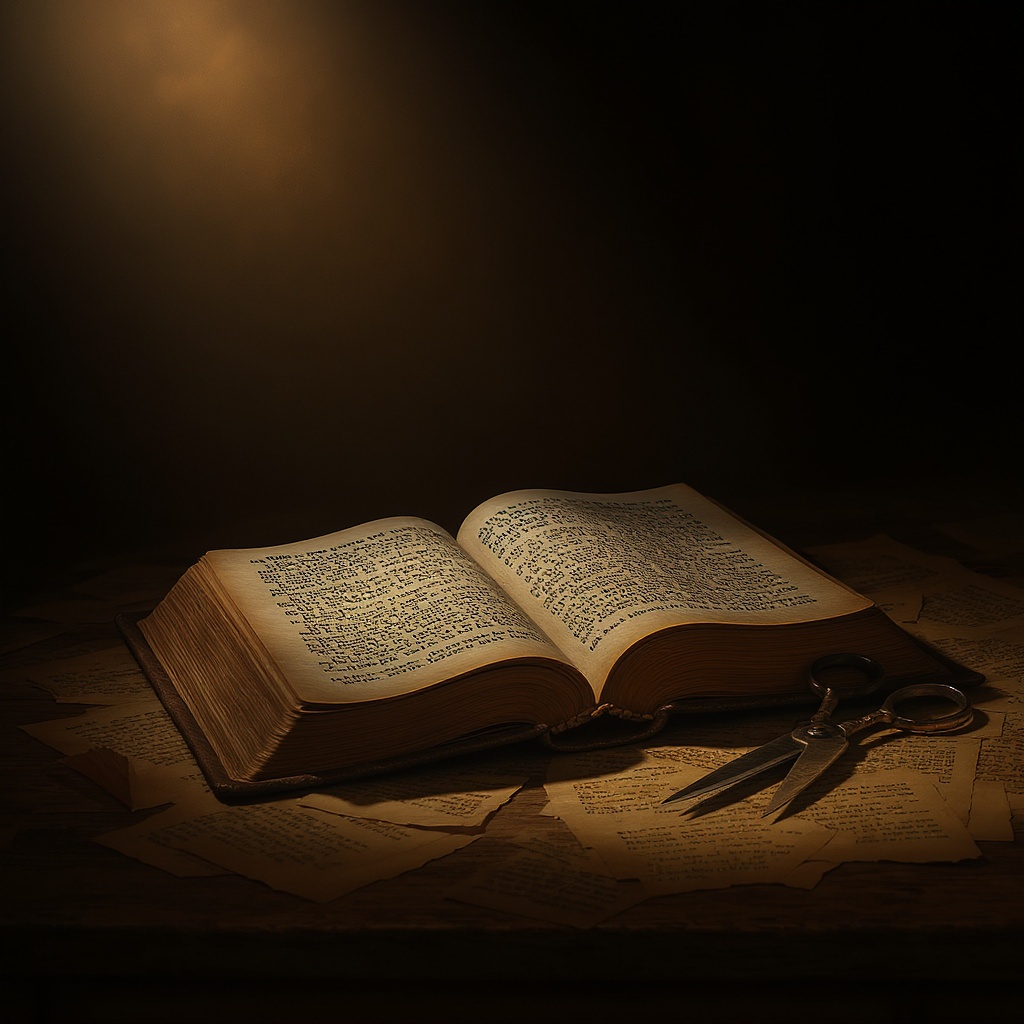
In April 1820, Thomas Jefferson sat at his desk in Monticello with a razor, a pot of glue, and four copies of the New Testament. He was seventy-seven years old. He had been thinking about this project for two decades. He had already told John Adams what he was looking for: a "philosophy of Jesus" — not a theology about Christ, but the actual words of a man he considered the greatest teacher of morality the world had ever produced.
What Jefferson made that year would eventually be called the Jefferson Bible. What the Gorham Bible does — nearly two centuries later — is finish what he started.
Jefferson's method was simple and ruthless. He obtained six copies of the New Testament in four languages — Greek, Latin, French, English — and with scissors and paste, he excised every passage that failed his single test: Does this reflect the pure moral teaching of Jesus, free of supernatural accretion and ecclesiastical interpolation?
What he cut tells you everything about what he believed was wrong with Christianity as it had been assembled.
Virgin birth. Jefferson found no evidence for it in Jesus's own words — and he was correct. The virgin birth appears in only two of the four Gospels. Jesus never mentions it. Paul never mentions it. Jefferson cut it.
Miracles. The feeding of multitudes, the walking on water, the raising of Lazarus — Jefferson saw these as later additions, the mythological freight that organized religion loads onto its founders. He kept the parables and the moral sayings. He cut the miracles.
The resurrection as cosmic event. Jefferson's Jesus rises in teaching and moral authority. He does not rise bodily from a grave. Jefferson described the resurrection accounts as "diamonds" scattered in a "dunghill" of myth — but even the diamonds, in his view, needed to be extracted from their context.
Paul. This is where Jefferson was most surgical, and most correct. In an 1820 letter to William Short, Jefferson called Paul "the first corrupter of the doctrines of Jesus." That is not a mild criticism. That is an accusation of systematic theological fraud. Jefferson's Paul is not a missionary. He is the architect of a religion that has almost nothing to do with the moral philosophy Jefferson found in Jesus's direct words.
"Had there never been a commentator, there never would have been an infidel." — Thomas Jefferson, letter to Francis Adrian Van der Kemp, 1816
Jefferson's thesis was not that Jesus was a moral teacher who happened to be ignored. His thesis was that a specific, identifiable set of authors — Paul first among them — systematically distorted Jesus's teachings and constructed in their place an institutional religion that bore Jesus's name but contradicted his substance. The New Testament, as assembled, was not a record of Jesus. It was an argument about Jesus, made by people who had institutional interests in a particular answer.
Join the Waitlist — Free
Get Chapter 1 of the Gorham Bible's editorial essays delivered to your inbox. No purchase required.
Join the WaitlistOr read the companion essay on Paul → · read Jefferson's Razor in the full essay →
The Jefferson Bible — what survived the scissors — runs to about eighty pages. It is concentrated in the Gospels, and it is concentrated in the parts of the Gospels that read like a philosopher's notebook: the Sermon on the Mount, the parables, the direct moral instructions.
Jefferson kept the core of what he called the "philosophy of Jesus." He kept it because it was coherent, because it was actionable, and because it did not require you to believe in supernatural machinery to apply it.
In 1813, in a letter to John Adams, Jefferson described what he found in those eighty pages:
"I have read his Communications [the New Testament] with the most profound attention. To my reading of them he seems to have given a more beautiful and affecting system of morality than has ever been taught by any other person." — Thomas Jefferson, letter to John Adams, April 11, 1813
Jefferson was not a Christian in any conventional sense. He did not believe in the resurrection, the Trinity, or the atonement. He was a deist with a deep respect for Jesus as a moral philosopher. But what he kept was not a philosophical abstraction — it was the actual recorded speech of a man he considered the supreme teacher of virtue.
That distinction matters. Jefferson was not editing Jesus's ideas. He was editing the record of what Jesus said. He wanted the words as delivered, without the theological scaffolding that later councils had built on top of them.
The "diamonds in a dunghill" metaphor appears in Jefferson's letters repeatedly. He found genuine moral and philosophical value in certain passages — but he was clear-eyed that the context in which those passages had been preserved was corrupt. The diamonds were real. The dunghill was the institutional apparatus that had assembled them into a religion Jefferson did not recognize.
Jefferson's project was brilliant and it was incomplete. He was working with scissors and paste. He was working alone. He was working with no distribution mechanism, no institutional support, and no audience beyond a small circle of intellectual correspondents.
The Smithsonian eventually obtained Jefferson's cut-and-paste manuscript and published it in 1902 — eighty-two years after his death. By then the cultural moment had passed. The Jefferson Bible became a curiosity, a footnote in the history of American rationalism, a thing you could buy in the museum gift shop.
What Jefferson could not do, in 1820, was build an interactive tool that let you read the Bible through his editorial lens — one where you could switch between his view and the canonical view, where you could see exactly why he cut what he cut, and where Paul's letters were not deleted but repositioned, contextualized, and understood as a distinct layer of theological development rather than a continuation of Jesus's teaching.
He had scissors. We have a database.
The Gorham Bible inherits Jefferson's thesis and builds it into a working tool. The base text is the 1599 Geneva Bible — the most widely read English translation in the English-speaking world at the time the King James was commissioned to replace it. It is the Bible Jefferson would have used. It is the Bible the Puritans brought to America.
On top of this text, we have applied Jefferson's editorial principle consistently and systematically:
Jefferson could not distribute his project. The Smithsonian did it for him, eighty years too late, and turned it into a museum gift shop item. The Gorham Bible is not a museum item. It is a working tool — the one Jefferson would have built if he'd had a server and a database.
The New Testament was assembled. It was not handed down from heaven. This is not a controversial historical fact — it is the consensus of every serious biblical scholar who has worked on the subject for two centuries. The 27 books of the New Testament were selected from a larger pool of competing texts through a process of ecclesiastical debate, political pressure, and theological negotiation that took roughly four hundred years.
Athanasius's Easter letter of 367 CE is the first document we have that lists exactly the 27 books that appear in our current canon. Before that, different churches used different books. Marcion — the second-century theologian who may have prompted the broader church to formalize its canon — used only a subset of Luke and Paul's letters, and he explicitly excluded the Old Testament entirely.
The canonical order — Gospels, Acts, Paul's letters, then everything else — was a theological argument, not a historical fact. It prioritizes Paul's authority. It places his interpretation of Jesus's life and teaching as the interpretive lens through which the Gospels are read. If you open a Bible and Romans is on page 457, you are reading the New Testament through Paul's eyes before you have finished the story of what Paul was supposedly interpreting.
Jefferson understood this. That is why his project was not merely a "best of Jesus" compilation — it was a direct challenge to the theological architecture of Christian institutional authority. Jefferson's scissors were pointed at the church's claim that Paul spoke for Jesus.
He was right. And the Gorham Bible is the digital version of being right.
"The Christian system, like all other systems, has been made by men, and like all other systems, it has been made worse by its subsequent commentators." — Thomas Jefferson, letter to William Short, October 31, 1820
Paul is not Jesus. Paul's interpretation of Jesus is not Jesus's teaching. The epistles that reshape Jesus's moral philosophy into a cosmological religion about Christ's death and resurrection are not a continuation of Jesus's words — they are a departure from them. Jefferson's scissors made this argument in eighty pages of cut paper. The Gorham Bible makes the same argument in a searchable, interactive, markup-colored reading tool.
The question the Gorham Bible asks is not "should you believe in the miracles?" It is: "Do you want to read what Jesus actually said, or do you want to read what Paul said about what Jesus said?" Jefferson chose the former. So do we.
New essays every few weeks — theology, history, and the editorial case for reading scripture without Pauline priority. One email per essay.
One confirmation email. Unsubscribe anytime.
Ready to read it?
The Gorham Bible is a one-time purchase. No subscription. No church affiliation.
Reserve Your Copy — from $9.99Reserve now, pay when checkout opens. ← Back to home